
Post / September 2026
Too many tokens, too little imagination
Until May 2, 2000, GPS was accurate to about 100 meters. It was degraded on purpose, and that day the restriction was lifted: accuracy jumped to around 5 meters. The next day Dave Ulmer buried a bucket with a can of beans in Oregon and posted the coordinates. That was the birth of geocaching. Nobody had put it on a roadmap. We lacked the imagination.
One of my favorite things to do in my classes is a small psychological experiment. Picture 30 or 40 people from every department of a company learning how to apply AI to the business... some more eager than others.
Before I teach anything, I ask them to spend 5 minutes listing ideas for how they could use it (call it ideation if you want to bill 5% more for being innovative, or if you speak tech Spanglish).
In the last one, with 40 people, we got 150 ideas. A sample:
- "Draft applications for public grants"
- "Speed up literature reviews"
- "Retrieve information easily through a chat"
- "A chatbot to help with IT device problems"
Three out of four are about doing what they already do, faster: drafting proposals, quotes and reports (about 25 ideas on that alone), searching internal documentation with a chat on top, summarizing papers. It is all efficiency gains and chatbots.
Now the experiment starts: I show them Hugging Face, the repository of AI models that Nvidia has agreed to buy and that OpenAI's models recently hacked.
Yes, I show it to non-technical users too (a terrible term: defining yourself by what you don't do is like calling yourself non-blond). Specifically, this Tasks section. I like it because it is a small tasting menu of what you can do.
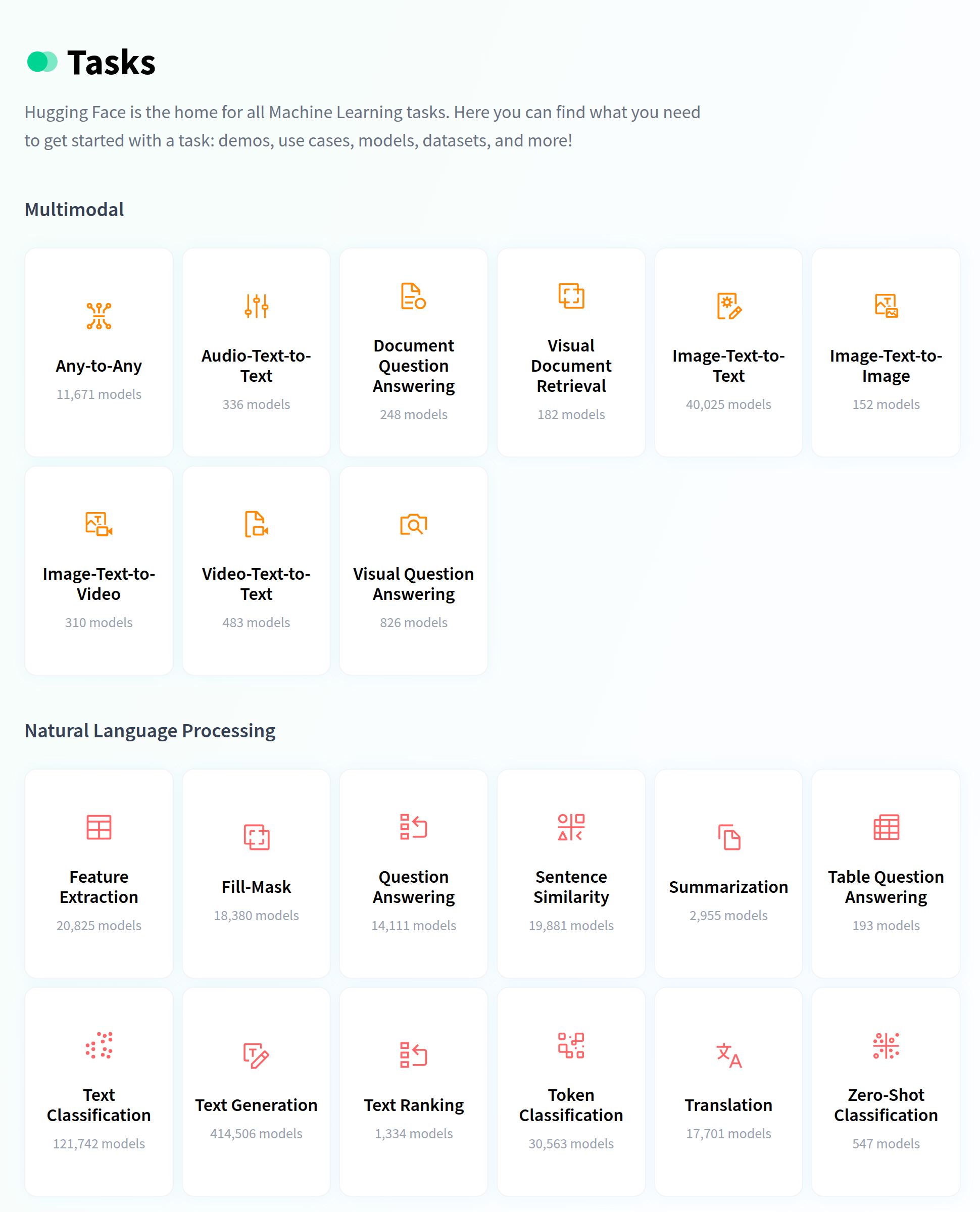
We repeat the list of ideas ideation session and this is what comes out:
- "Analyze video to detect risky situations"
- "Track mood from video"
- "Rebuild a space in 3D from photos"
- "Classify images to find where the problem is"
- "Test a product with synthetic users before showing it to customers"
- "Have an agent attack our own applications to find flaws"
- "Turn a hand-drawn sketch into a product design"
Much better, right?
Psychology already knew this: it is very hard to imagine something you have no words for. That is why it matters so much to expand your vocabulary, understand the technology you want to work with and talk to people whose profiles are different from yours. Nothing makes sense until the pieces click and, voilà!, you have a great idea.
Something similar happened in 2019, when teams building AI products had to rely on guides like Google's PAIR or Microsoft's to teach product teams what was possible and how to build it into their products.
Today asking for a recommender in a feed is obvious: Spotify, Twitter or TikTok are natural experiences we all know. But before that, someone had to explain what one was.
Today everyone knows what a swipe left means in a mobile interface, but not long ago building mobile apps came out of a company's innovation budget. And Steve Jobs had to deliver his famous line, "an iPod, a phone, and an Internet communicator… are you getting it?", to explain what an iPhone was.
There is a period of intense innovation in which the key is to build a shared language and add new pieces to your toolbox, simply to imagine better.
Who would have thought: "wasting time reading useless stuff" turns out to have an ROI.
Where ideas go when they are not in a backlog
In 2012 a neural network, AlexNet, a precursor of the AI we now use every day, was trained on two GTX 580 graphics cards that cost 499 dollars each and were designed for video games. Computing that got cheaper for gaming ended up producing the cheap tokens this piece is about. And people say video games are useless.
When a resource becomes massively cheaper and accessible, it transforms industries: it happened with home printers, GPUs, personal computers, mass car manufacturing, internet access and so on.
Scale unlocks new applications. The same thing is happening with AI:
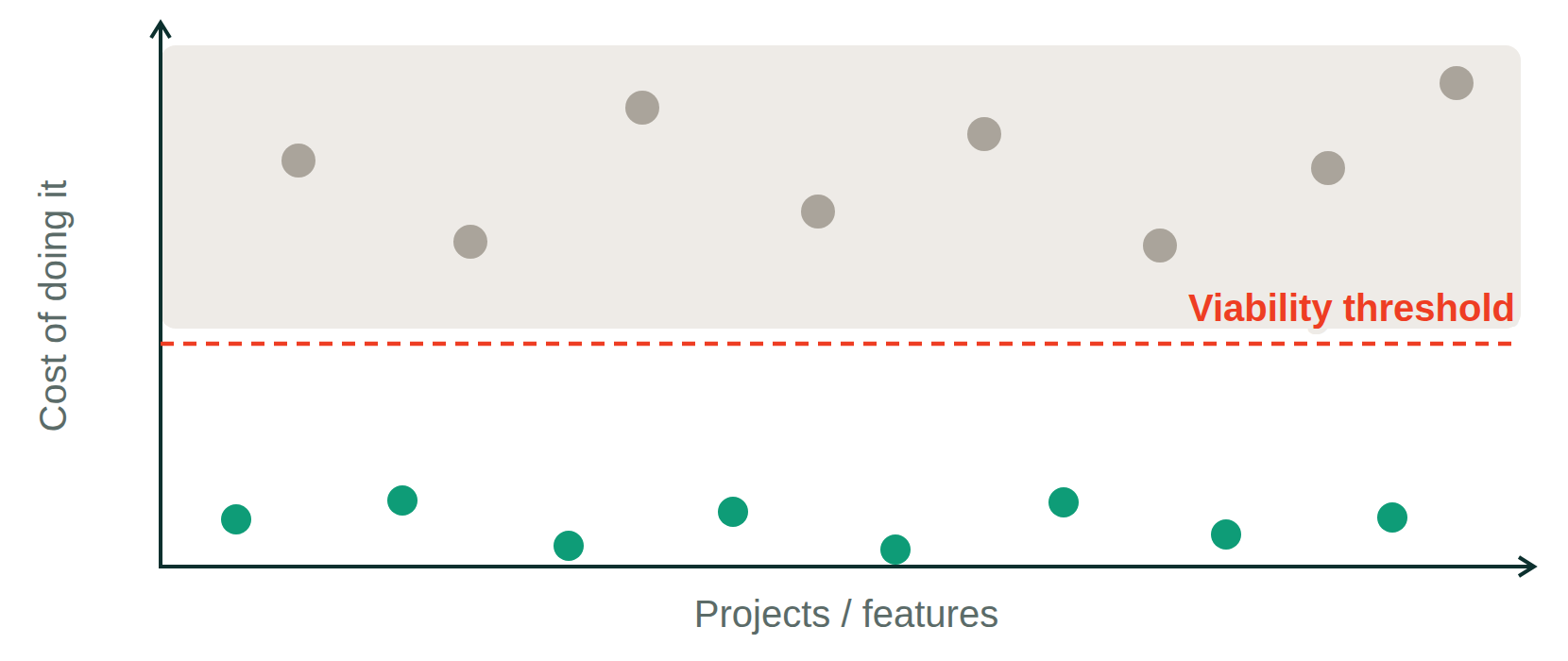
When I explain this, I use this chart. Each dot is a project we could carry out, and its height is what it would cost. The red line is the viability threshold: above it, the project is not worth the cost and never even gets proposed.
This line is not only about economic viability, it is also about visibility: sometimes we are blind to those ideas simply because they never occurred to us.
If you remember the experiment, the first thing almost everyone does with AI is push down what was already below the line: the same thing, cheaper. That is the boring (and necessary) part.
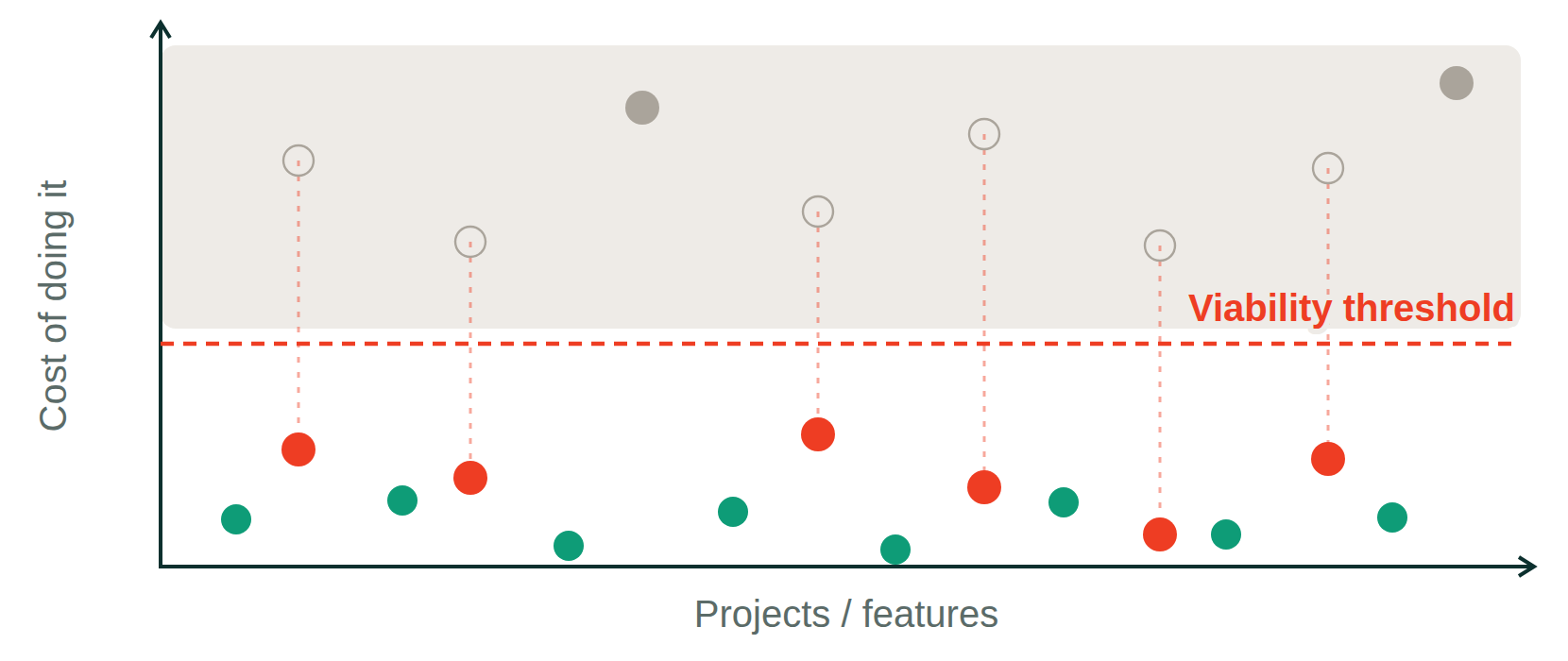
The interesting part is bringing down what used to be impossible. That is where new products appear, and it is what we ignore the most.
Liquid cognition
So how do you think about something that does not exist? How do new product categories get made?
We call thinking differently "lateral thinking". It is lateral because it comes from a different angle. We need a mental frame that "unlocks" new ideas. A GPU is a card for rendering graphics, but seen from another angle it is a computer optimized for multiplying matrices.
For me (and I hope for you) it is very useful to think of tokens as "liquid cognition". Traditionally, your team's cognitive capacity grows and shrinks slowly: as new talent joins or the team gets smaller. There is a speed limit, and if you hire too fast, bad things happen.
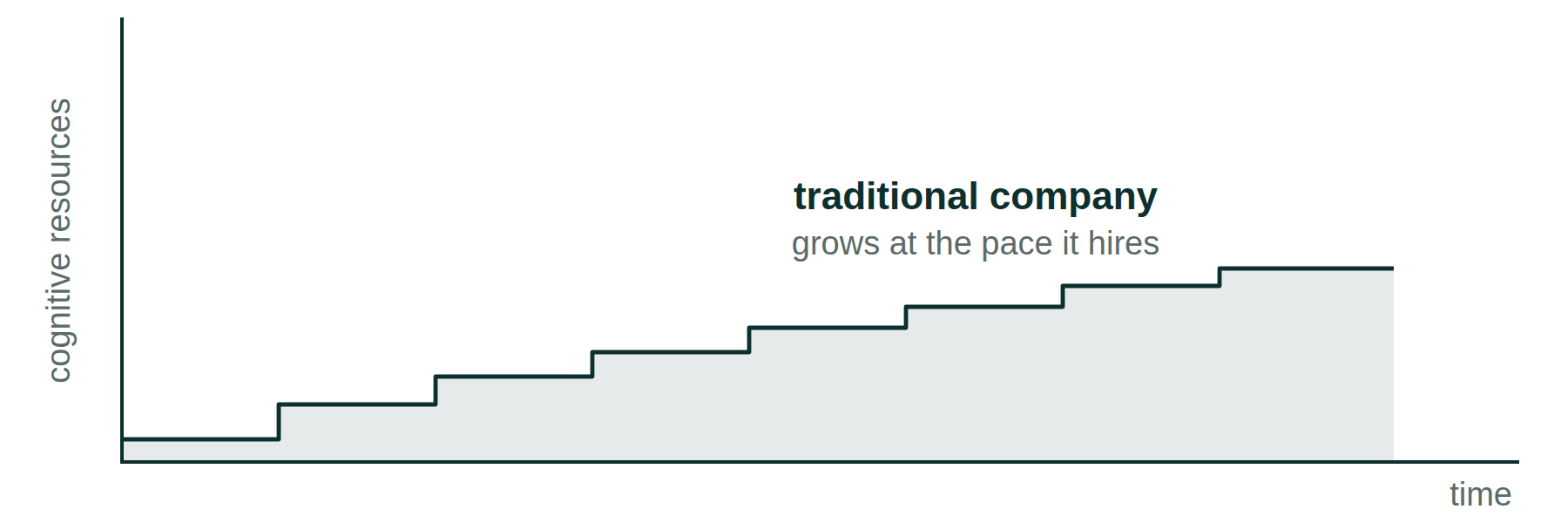
But with AI we can buy "intelligence" tokens in liquid form. If you want to spend tens of thousands of dollars on solving a problem for a few hours, you can.
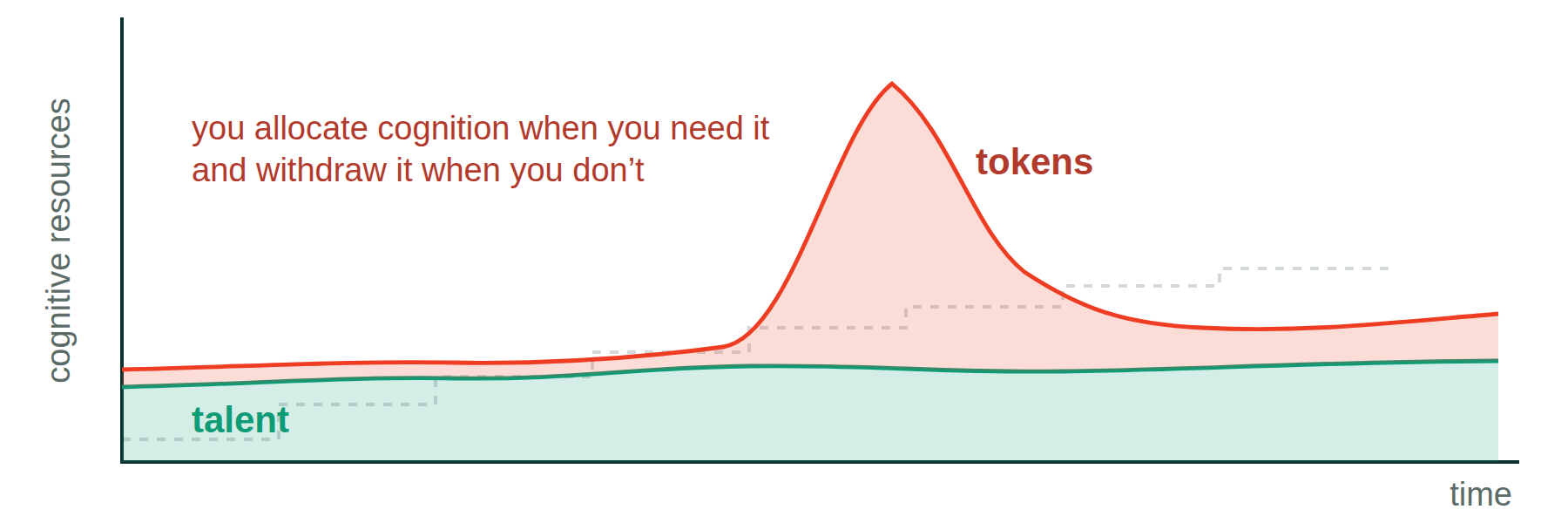
So the key question is: what used to be impossible for lack of cognitive resources?
Can we tailor every product description in an online store to each user?
Can we "draw" architectures in UML and have them programmed? (Uncle Bob already does it)
Can we review 10,000 active contracts every time a law changes and get told which ones are a risk?
Can we reproduce every bug in the backlog, record it on video and prioritize it by how visible it is?
Can we analyze the logs of all our users and see what they actually use our application for?
Can we build a working demo with each customer's data before a first call?
Can we migrate a new customer from a 2015 Excel file full of macros to our SaaS just by asking them to drag and drop it?
Can we analyze every recorded session of our users, and not just a sample from the UX study?
Can we cross-check every minor public contract and detect when a large one is split up to avoid a public tender? (@naroh is already doing it)
Yes, we can. And we should. Because, as Clarke's third law says, "any sufficiently advanced technology is indistinguishable from magic".
It is no coincidence that those laws were written in "Hazards of Prophecy: The Failure of Imagination". Amid so many doom-laden messages about the end of programming, I suggest we ignore the prophecies and build the impossible: what nobody had ever put on a roadmap. We have no shortage of imagination, and tokens to spare.